Introduction
Most people don’t spend much time thinking about home security.
Until something feels off.
Maybe it’s a random noise at night. Or a notification you didn’t expect. Or just that gut feeling when you leave the house—“Did I lock everything properly?”
Now imagine your alarm goes off while you’re not home.
Not checking your phone. Not nearby. Just… gone.
So what happens?
Does someone step in and handle it?
Or does it just keep ringing while nothing really gets done?
That’s the difference between monitored and unmonitored alarm systems—and yeah, it’s a bigger deal than most people think.
Let’s walk through it without the technical jargon.
What Is a Monitored Alarm System?
Here’s the simple idea
A monitored system means you’re not handling everything alone.
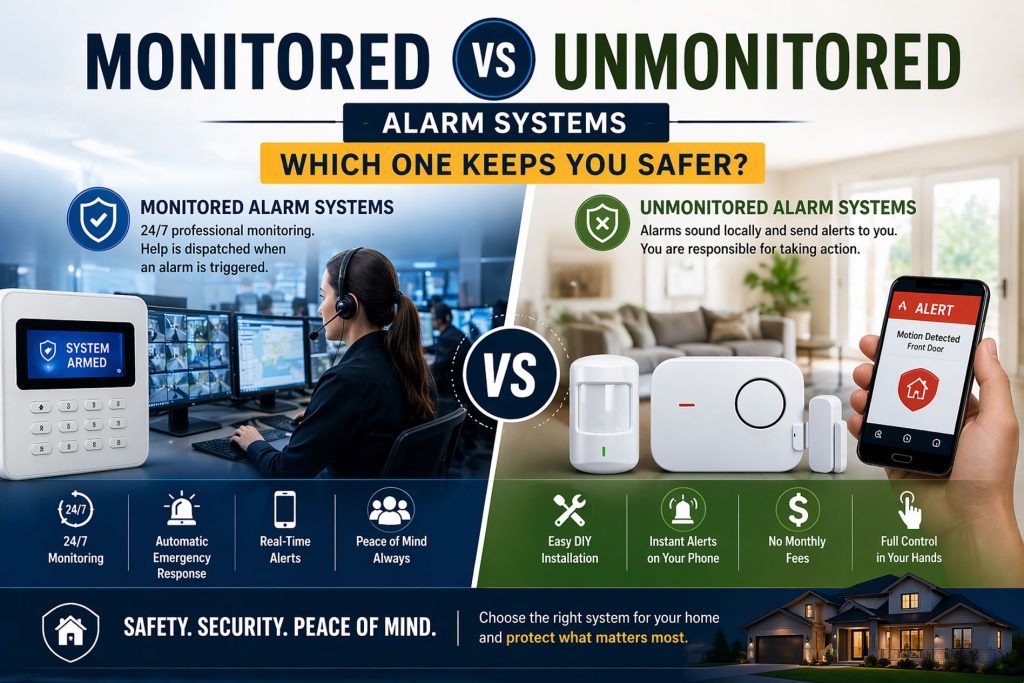
If something triggers your alarm, it sends a signal to a monitoring center where actual people check what’s going on. From there, they can call you, verify the situation, and—if needed—contact emergency services.
All of that can happen in minutes. Sometimes faster.
Even if you’re asleep. Or busy. Or nowhere near your phone.
Why people lean toward monitored systems
It’s mostly about peace of mind.
You don’t have to:
- Constantly check notifications
- Worry about missing something important
- Be the one making the call in a stressful moment
And honestly… that matters more than people expect.
But yeah, there’s a trade-off
- You’ll usually pay a monthly fee
- You’re relying on a service provider
For some people, that’s a downside. For others, it’s the whole point.
What Is an Unmonitored Alarm System?
This one’s more straightforward
An unmonitored system does exactly what it sounds like—it alerts you, and that’s it.
If something triggers it:
- A loud siren goes off
- You might get a notification
And then… it’s your move.
Call the police? Ignore it? Check the camera? It’s all on you.
Why people choose this option
A lot of it comes down to simplicity.
- No monthly bills
- Easy to install
- Full control over everything
And for some setups, that’s honestly enough.
Where things can get tricky
Here’s the part people don’t always think about:
What if you don’t see the alert?
It happens more than you’d expect.
Phones on silent. Dead battery. Busy day. Bad signal.
In those moments, the system doesn’t really do anything beyond making noise.
Monitored vs Unmonitored: The Difference That Actually Matters
You can compare features all day, but it really comes down to one thing:
👉 Who takes action when something goes wrong?
- Monitored → someone steps in for you
- Unmonitored → you handle it yourself
That’s it.
Everything else is secondary.
So… Which One Is Safer?
If we’re being straight about it?
👉 Monitored systems are safer.
But let’s not oversimplify it.
They’re safer because they remove the biggest risk: you not being able to respond in time.
Think about it:
- What if your phone is on silent?
- What if you’re in a meeting?
- What if you’re on a flight?
With a monitored system, those situations don’t matter. Someone else steps in.
With an unmonitored system… it’s all on you.
What Makes Sense for Your Situation?
If you’re a homeowner
You’re probably thinking long-term.
You want something reliable. Something you don’t have to constantly think about.
That’s where monitored systems usually make more sense—especially if:
- You have a family
- You travel occasionally
- Your home isn’t always occupied
If you’re renting
Different story.
You might not want to install anything permanent or commit to ongoing costs.
Totally fair.
A simple unmonitored system—or even a flexible DIY monitored one—can still give you a decent level of security without overcomplicating things.
Let’s Talk About Cost (Because It Always Comes Up)
At first glance, unmonitored systems look like the obvious winner.
No monthly fees. Lower upfront cost. Done.
But here’s the part worth thinking about:
👉 You’re not just paying for equipment with a monitored system—you’re paying for response.
And that’s hard to put a price on until you actually need it.
When a Monitored System Just Makes Sense
You’ll probably appreciate it if:
- You’re not always glued to your phone
- You travel or stay away overnight
- You don’t want to deal with emergencies yourself
- You just want things handled automatically
It’s less about features—and more about not having to think twice.
When Unmonitored Is Totally Fine
It works well if:
- You’re home most of the time
- You’re okay being the one who responds
- You want something simple and affordable
- Your area feels relatively safe
For a lot of people, that’s enough.
A Quick Reality Check (Most People Skip This)
Your alarm system is just one part of the picture.
Even the best setup won’t do much if everything else is weak.
A couple small things can make a bigger difference than you’d expect:
- Adding a camera or two
- Using smart locks
- Actually turning on notifications (sounds obvious, but still)
- Testing your system once in a while
Security works best in layers. Not just one device.
So… What Should You Do Next?
If you’re still unsure, that’s normal.
Most people don’t know which direction to go until they see what fits their space and routine.
👉 The easiest next step?
Get a quick home security recommendation based on your setup.
No guessing. No overthinking.
Just clarity.
FAQs (The Stuff People Usually Ask Last-Minute)
Are monitored alarm systems really worth it?
If you want someone else to handle emergencies—yes. That’s really what you’re paying for.
Do unmonitored alarms contact the police?
No. You’ll need to do that yourself.
What if my alarm goes off and I miss it?
With monitored systems: someone else steps in
With unmonitored systems: nothing happens
Can renters use monitored systems?
Yeah, there are plenty of no-contract, easy-install options now.
What’s the easiest system to start with?
Unmonitored is simpler upfront—but monitored isn’t complicated anymore either.
Conclusion
If you strip everything down, it’s really about one thing:
👉 Do you want backup when it matters most?
Because when something actually happens, that’s the moment that answer matters.