Most burglars aren’t criminal masterminds. They’re opportunists. They want the fastest way in with the least amount of noise and the smallest chance of getting caught. And it turns out, most homes have a handful of weak spots that show up again and again in burglary reports. So let’s walk through them, because once you know what they are, they’re surprisingly easy to fix.
The Front Door (Yes, Really)
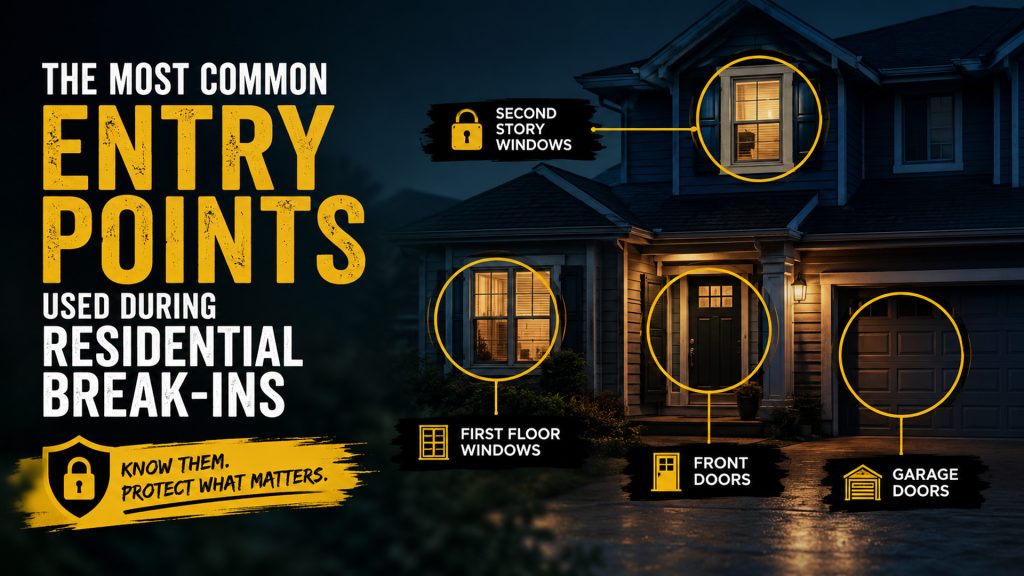
This one takes people by surprise You might think that burglars would stay away from the front door since it’s the most visible one but actually it’s one of the most favorite entrances for burglars. Why? Because most front doors are so easy to be broken by a kick that even a lot of homes are still using weak strike plates or short screws that don’t even reach the stud in the door frame.
If a burglar manages to kick your door couple of times it’s not necessary for him to pick your lock. That’s the unpleasant truth. However it’s not hard to repair the situation, a reinforced strike plate with 3-inch screws a solid core or metal door and a deadbolt which really goes into the frame will change the situation very much. This is one of those inexpensive improvements which is highly effective.
First-Floor Windows
Windows rank just below doors as burglars’ favorite points of entry. They really love windows that are so well hidden from the street by bushes, fences, or the side of the house, that you can’t even see them. Anything out of view of neighbors or passing cars is even more attractive, as the miscreants feel there is less likelihood of someone spotting them.
Moreover, many windows in old homes are fitted with very weak latches that hardly make an obstruction. A good few of them can be quickly opened with a flathead screwdriver within through. If you have windows that are out of sight, then it is at such places where you should be directing your concern in terms of security measures the most upgrading the locks, installing window sensors, or even just cutting back the landscaping so that there is no place for someone to hide while breaking in.
The Back Door
Back doors are always getting targeted, and it totally makes sense when you think about it. They’re usually out of view from the street, and people tend to treat them as an afterthought compared to the front entrance. Sliding glass doors are a particular favorite for burglars because older ones can sometimes be lifted right off their track, or the lock mechanism is just plain weak.
If your door is a sliding one, a straightforward technique could be to place a wooden rod or metal strip inside the track. It almost sounds too simple, but in fact, it works by literally preventing the door from being slid open, even in the event that the lock is broken by an intruder. Inexpensive, highly efficient, and requires only a few minutes to install.
Garages
This is the one people forget about constantly. Garages get broken into in a few different ways — sometimes through the side door, which often has worse security than the main house, and sometimes through the garage door itself if it’s an older model without rolling-code technology (meaning the signal can be captured and replayed).
There’s also the classic move where someone breaks into the garage, then uses the interior door into the house, which is often left completely unlocked because, hey, it’s already inside the garage, right? That interior door deserves the same lock quality as your front door. It’s an easy blind spot.
Second-Floor Windows (More Than You’d Think)
You’d assume upper floors are safe just by being harder to reach, but burglars use ladders, trellises, fences, and even stacked patio furniture more often than people expect. If there’s anything near your house that could function as a step stool to a window, it’s worth moving or securing.
This is especially true for homes with attached structures like garages or sheds with flat roofs that lead right up to a second-story window. It’s an easy path that a lot of homeowners never even think about because their brain says “second floor equals safe.”
Basement Entrances
Basement windows and doors are an underrated risk because they’re low to the ground, often poorly lit, and rarely visible from the street. They also tend to have weaker frames since basements weren’t always built with the same security standards as the rest of the house.
If your basement has a walk-out door or windows at ground level, treat them with the same seriousness as your front door. Just a motion-sensor light can work quite well in scaring burglars away as they usually stay away from anything that attracts attention.
What Actually Helps
After digging through all this, a few patterns become pretty clear:
Visibility matters more than people think. Burglars avoid being seen. Motion lights, trimmed shrubs, and a clear line of sight from the street can discourage a break-in before it even starts.
Doors fail more from hardware than from the burglar’s skill. Reinforced strike plates, quality deadbolts, and solid frames make forced entry significantly harder.
Cheap fixes go a long way. A dowel in a sliding door track, a window sensor, a motion light — none of these cost much, but they remove the easy wins that opportunistic burglars are looking for.
The weakest point sets the tone. If one entry point on your home is noticeably easier than the rest, that’s the one that gets targeted. Burglars aren’t trying to break into your house in general — they’re trying to find the single weakest spot and exploit it.
Conclusion
None of this is about turning your home into a fortress. It’s mostly about closing the gaps that make a burglar’s job easy. A few small upgrades to doors, windows, and garages go a long way toward making your home a less appealing target — and in most cases, burglars are looking for the path of least resistance, not a challenge.
If there’s one takeaway here, it’s this: walk around your own house like you’re trying to break in. Check what’s hidden, what’s flimsy, and what would take less than thirty seconds to force open. That short exercise alone usually reveals more than any security checklist ever could.