Most of us who own a house would have the idea that after fitting and paying for your alarm system, everything that you touch, you control it. You input your password, the house is armed or disarmed, and the job is over. However, the fact is there another whole level beneath that simple code which few people ever see, that is, in fact, why your alarm technician has much more authority over your system than you could imagine.
This level is known as the installer code, and knowing about it will definitely change your perception of who really owns your alarm system.
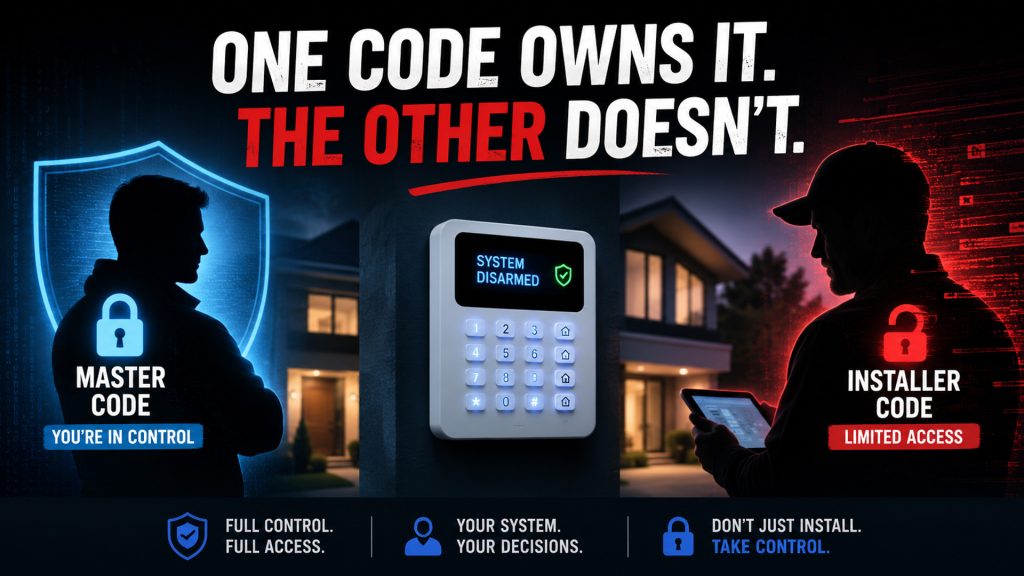
Two Codes, Two Very Different Jobs
Every alarm panel worth installing runs on a two-tier code structure.
Your master code handles the everyday running of the system — arming, disarming, adding a code for a family member, changing your own PIN. This is the code you’re given on day one, and it’s the only one you’ll ever really need for normal use.
The installer code sits behind that. It’s the access point for deep programming: setting up zones, connecting wireless sensors, configuring tamper and fire protection, and telling the panel how to communicate with the monitoring station. It’s a technician’s tool, not a homeowner’s.
The question is: if you own the hardware, why don’t you automatically get both?
The Case for Keeping the Installer Code Locked Down
There are legitimate reasons alarm companies are cautious about handing this over, and they’re not just about control for control’s sake.
A wrong click can break more than you’d think. Someone without training exploring the programming menu could easily disable a fire zone, delete a sensor, or accidentally switch off communication with the monitoring centre — all without realising anything happened until there’s an actual emergency and nothing calls out for help.
Consistency matters more than people realise. When only the installer does the programming, the system stays in a known, well-documented condition. It probably seems insignificant until some problem arises and a technician has to find out what went wrong which is quite a fast job if the set-up was left untouched, and can take a lot longer if the configuration has been changed.
Your monitoring depends on settings staying untouched. If your alarm is professionally monitored, the reporting and communication configuration is what actually gets a response out to your property. Change the wrong setting and the alarm might still go off — but nobody on the other end will ever know.
Troubleshooting relies on a clean paper trail. A tech who knows nobody else has been in the programming can usually pinpoint a fault fast. Once outside changes are in the mix, every fault call becomes guesswork.
Then there’s the less flattering reason. Some companies withhold the installer code simply to keep future servicing locked in with them. It’s not a technical safeguard at that point — it’s a retention strategy, and it’s fair for customers to question it when it comes up.
But There Is Another Side to the Argument
The point here is that the homeowner is still entitled to the installer code even without having a service contract on file with the professional. For example, a home has an alarm system installed, and the owner has the complete title, with no service agreement that says otherwise, it’s fair to assume that the home owner would still be able to ask for their installation code. After having a copy:
- You would not be dependent on any particular contractor to handle your future maintenance calls.
- On a technical level, if you are familiar with the system it may allow you to customize certain features and not have to rely on an outside company.
- You should also not be coerced into purchasing a new alarm system merely because of some reluctance to unlock an older one by a company of your choice.
Ultimately, you are the rightful owner of your house. It is hard for an installer to defend him/herself against such situations when he/she is withholding the access, the equipment, and the justification in one go。
What a Fair Arrangement Actually Looks Like
The top alarm companies, instead of being rigid about the issue and sticking to one side or the other, settle it by being fair and giving the customer the right to access the system and at the same time being able to carry out repairs on the system.
Happily they will give you the master code so you don’t get locked out of using your own system daily. The technician keeps the installer code so he can do regular servicing, but they don’t keep it secret permanently, the code will only be given to you if you specifically ask for it and demonstrate an understanding of what you are getting into. Once your contract ends, your system is completely paid off, or ownership changes hands, they will automatically pass the installer code to you.
It is the perfect compromise to prevent the system from being harmed, whether unintentionally or intentionally, and at the same time it honors your role as a customer by acknowledging the fact that the purchase was made for your use only.
Conclusion
The installer code isn’t a conspiracy — it’s a safeguard designed to stop untrained hands from breaking something that could matter in an emergency. But it also shouldn’t be a permanent lock that keeps you from your own equipment. If you own your system, asking your provider for the installer code — especially once your service agreement wraps up — is a completely fair request, and any reputable installer should be able to talk you through it without dodging the question.