
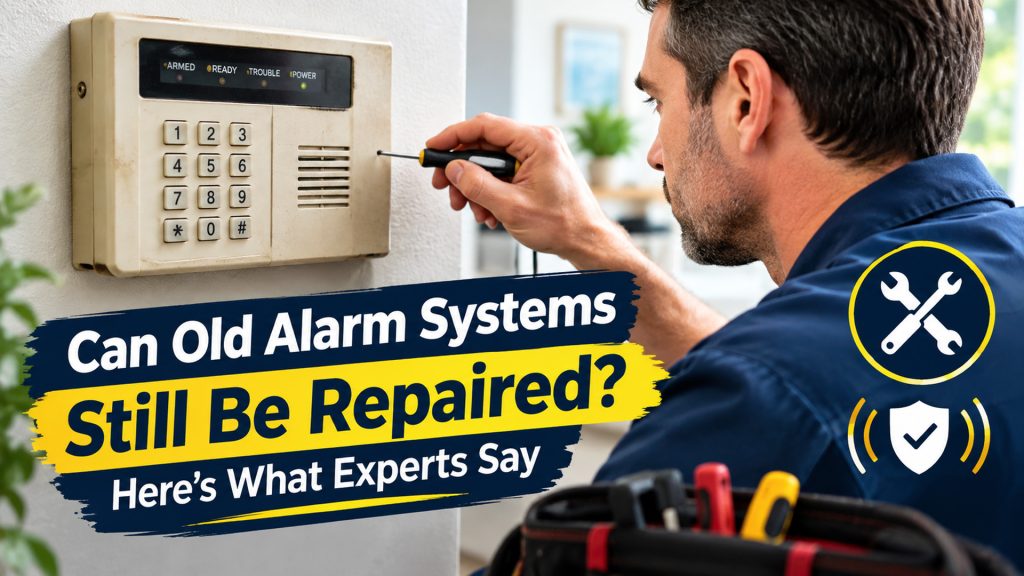
If you’ve had the same alarm system since your kids were in primary school, you’re probably wondering whether it’s finally time to rip it out and start fresh, or whether it’s still got a few good years left in it. It’s a question we get asked constantly, usually right after someone’s system starts beeping at 2am for no reason, or the keypad stops lighting up properly.
The honest answer is: it depends. But more often than people expect, an older alarm system can be repaired rather than replaced. Here’s what we tell homeowners when they call us about a system that’s seen better days.
Old Doesn’t Automatically Mean Dead
There’s a common assumption that once an alarm system hits a certain age, it’s basically e-waste. That’s not really true. Plenty of the systems we service across Sydney homes are ten, fifteen, even twenty years old, and they’re still doing their job just fine with the right maintenance.
What actually determines whether a system is repairable usually comes down to a few things: how well it’s been looked after, whether parts are still available for it, and what’s actually gone wrong. A sensor that’s stopped working because of dust buildup is a completely different problem to a control panel that’s fried from a power surge. One’s a quick fix. The other might mean it’s time to talk about upgrading.
The system itself being “old” isn’t really the deciding factor. It’s more about what’s broken and why.
The Most Common Repairable Issues
We see the same handful of problems over and over again, and most of them are fixable without needing to replace the whole setup.
Battery failure is probably the biggest one. Alarm systems run on backup batteries so they still work during a power outage, and those batteries degrade over time just like any other battery. If your system’s been chirping intermittently or the panel’s showing a low battery warning, that’s often all it is. Cheap fix, quick job.
Another major cause would be the accumulation of dust and high humidity in the equipment housing, which is most noticeable in Sydney where we have both coastal humidity and dry heat as determined by the season. Sensor malfunctions can result from the deposition of contaminants and moisture getting where it is not supposed.
Wiring issues are another one, particularly in older homes where the alarm was installed before renovations happened around it. Sometimes a wire’s been nicked, chewed by a pet, or just worn down over the years. Tracing and repairing a wiring fault is usually straightforward for a technician who knows what they’re looking for.
The last point would be the keypad or panel display malfunction, where the whole system’s brain is usually the first suspicion of the problem. But as a matter of fact, very often it is a display component that is worn out or a connection behind it has become disconnected.
When Repair Starts Making Less Sense
There are situations where patching things up stops being the smart move, and we’ll always tell clients straight if that’s the case rather than charging for repairs that won’t hold.
The big one is parts availability. Alarm technology moves fast, and manufacturers eventually stop producing components for older models. If your system is a discontinued line and the specific part that’s failed simply isn’t manufactured anymore, repair isn’t really on the table no matter how much we’d like to help.
Monitoring compatibility is another issue that’s become more relevant recently. A lot of monitoring stations have been shifting away from older communication technology toward newer network-based systems. If your alarm relies on a type of connection that’s being phased out, you could end up with a perfectly working alarm that simply can’t talk to the monitoring centre anymore. That’s less about the alarm being broken and more about the world moving on around it.
And then there’s the accumulation problem. One fault here and there is normal wear and tear. But when a system needs its third repair in eight months, that’s usually a sign it’s on its way out rather than genuinely fixable long-term. At that point you’re spending money to delay the inevitable rather than actually solving anything.
What a Technician Actually Checks
When one of our techs visits an older security system and checks it out, it’s more than just a casual glance and a guess. Not only do they verify whether the control panel is receiving and processing signals correctly, they also check each sensor individually rather than just assuming they’re working after a single sensor was triggered, inspect the wiring for any signs of corrosion or damage, and finally check whether the old system is still connected and operating normally to the monitoring services.
We’re telling you this because alarm systems quite often fail in subtle ways that are invisible to the naked eye. The system may appear to be in perfect condition, able to lock and unlock without a problem, but actually have a motion sensor that’s been inactive for months. Such defects can only be detected during a thorough check and definitely are not something you could have spotted just by doing your regular routine.
So Should You Repair or Replace?
Sometimes fault isn’t in the whole system but one particular part like a battery, sensor, or wiring issue in those situations, you can be pretty certain, repair is the most economical choice. It is cheaper, faster and there is also the reason of not throwing away something that still works quite fine fundamentally.
If you’re dealing with obsolete parts, monitoring compatibility problems, or repeated failures across different components, that’s usually the point where replacement makes more financial sense than continuing to patch things up.
Honestly, you might get the idea just through the age and that this system is not going to last you. The best thing for this system, in particular, is getting someone qualified and actually looking at it rather than you being the one to guess.
We have had many of such cases where the customer called us saying, “this thing’s ancient, just replace it”. Once a technician took a tech support look after opening the panel up, many times simple repairs became the solution. On the contrary, we had some instances of newer systems being replaced with a complete installation even due to a wrong installation.
If your alarm has started misbehaving and you are not sure you should replace just the alarm or throw the whole thing away, get a checkup done on it beforehand. There are instances where an old system just needs a bit of care and maintenance to be able to do exactly the same as before.
.
FAQ
How do I find out if my alarm system is so outdated that it is better repaired? Age is not the only factor, the thing to look for is whether you can still get parts and how bad the system has been in failing lately.
Is Repairing older alarm systems a cheaper alternative as compared with replacing them? Repairing only one aspect -for example, batteries, or sensors, if not more, can be a lot cheaper than buying a whole new system if the parts can be sourced easily.
Will the old alarm system interface with monitoring services? It depends. Some of the aged alarms rely on a type of communication that monitoring stations no longer support, in which case monitoring could not work even if alarm is perfectly working.
How often should you check an alarm system? One inspection every year is a pretty reasonable estimate. However, if the home has pets, the wiring is old, or the environment has high humidity, the system can be serviced more frequently than that.


